
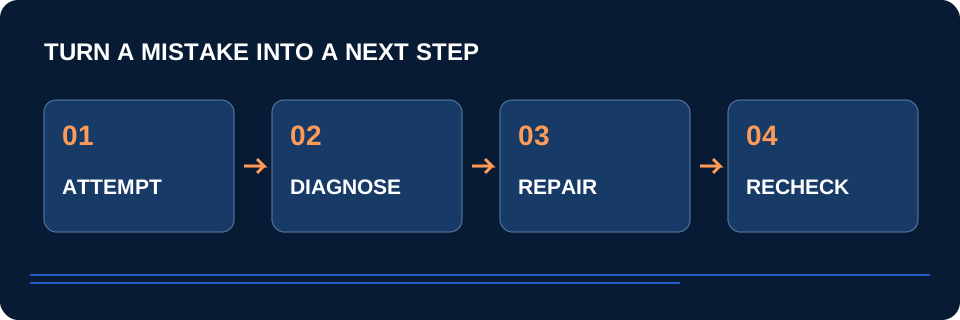
- Record the exact step where your reasoning changed direction.
- Separate concept gaps from algebra slips, reading mistakes and time choices.
- Close an entry only after you can explain and apply the repair independently.
What belongs in a useful maths error log?
Use one entry for a meaningful mistake or recurring pattern. Record the topic, a question reference, your original method, the reason it failed and the next practice task.
You do not need to rewrite the entire source question if the reference lets you find it again. Keep the log close to your normal revision material.
A short entry that changes tomorrow’s practice is more useful than a polished record you never reopen.
Find the first wrong step before naming the error
Look at your written working before reading a model explanation. Identify the first step that was not justified, then ask what caused it.
If you did not know an algebra rule, record a concept gap. If you knew the rule but omitted a term, record the exact slip.
If you solved for a different quantity from the one requested, record a reading error. Avoid using “careless” as a complete diagnosis because it does not tell you what to do next.
Put this into context: How to analyse a mock test beyond the score.
Worked example: check the expansion
Consider this original practice question: solve 3(x − 2) = 2x + 5. It is an illustrative algebra example, not a reproduced UPSC question or a claim about a particular exam’s difficulty.
An incorrect first line might be 3x − 2 = 2x + 5. The problem begins when 3 is not applied to both terms inside the bracket.
The correct expansion is 3x − 6 = 2x + 5. Subtract 2x from both sides to get x − 6 = 5, then add 6 to obtain x = 11.
Check the answer in the original equation
Substitute x = 11 into the original expression. The left side is 3 × (11 − 2) = 27, and the right side is 2 × 11 + 5 = 27.
Both sides agree. Checking the original equation matters because checking only a later, incorrect line may repeat the same mistake.
The reusable lesson is to apply multiplication to every term inside a bracket and verify the result against the problem you were actually given.
Write the repair, then try a transfer question
A useful next action is specific: expand the bracket explicitly, solve a fresh equation and substitute the result. Try 4(y − 3) = 2y + 10 without looking at the answer first.
The correct working is 4y − 12 = 2y + 10, so 2y = 22 and y = 11. Substitution gives 32 on both sides.
This fresh question checks the same underlying operation; solving it once does not prove mastery of all algebra topics.
Choose a review time you can keep
Schedule a short return to the entry after your initial correction, then revisit it within your normal revision cycle. The exact interval should fit your workload and whether the idea remains difficult.
At review, cover the old solution and explain the method from the question. If you cannot reproduce the reasoning, reopen the entry and reduce the difficulty of the next practice task.
Do not mark it complete simply because the explanation looks familiar.
How do you use the log during mock review?
After a mock, select the mistakes that are most useful to address next. Group repeated causes so ten similar errors do not become ten copies of the same note.
Keep uncertain correct answers on the review list too: a lucky answer can hide a gap. Use the mock-analysis guide for the whole paper and this log for the specific mathematics repair.
Return to the official syllabus and suitable question papers when choosing the scope of your next practice set.
Turn the log into a conversation with your teacher
Bring the original attempt, your diagnosis and the transfer question to a doubt discussion. Ask which step is unjustified or which method would make the reasoning clearer.
If you cannot explain why the repair works, say so directly. When exploring a course, ask how teachers review students’ written working and recurring errors.
The academy must confirm its actual doubt-support format; this guide describes a learning practice, not a promise about a currently available Tejas batch.
Your maths error-log template
This completed example uses the original algebra problem above. Replace it with your own question reference and working.
| Field | Example entry |
|---|---|
| Topic / question | Algebra · 3(x − 2) = 2x + 5 |
| First incorrect step | Wrote 3x − 2 instead of 3x − 6 |
| Cause to check | Did not multiply every term inside the bracket |
| Correct reasoning | 3x − 6 = 2x + 5 → x = 11; substitution: 27 = 27 |
| Next action | Solve 4(y − 3) = 2y + 10 independently; verify both sides |
| Review result | Fill after trying again: independent / needed a hint / revisit |
Use the template in five steps
- Save the question reference and your original attempt.
- Identify the first unjustified step.
- Write the cause and the correct reasoning in your own words.
- Try a fresh question that tests the same idea.
- Schedule a review and record what you can do independently.
For the whole-paper review, continue with how to analyse a mock test. For authentic practice material, read how to use official previous-year papers.
Official references and scope
These notes provide original, general preparation guidance. Use the official authority for examination rules and current notices; the article does not determine individual eligibility.
UPSC: active examinations — verify the current syllabus and scheme UPSC: previous-year question papers for practice contextCommon questions
Should I record every incorrect question?
Record errors that reveal a gap, recurring pattern or useful decision. Group repeated causes and keep enough question references to revisit them without copying every solution.
What should I do with a correct answer that I guessed?
Mark it as uncertain and review the reasoning. A correct option alone does not show that you can explain or repeat the method.
Can I keep the log on paper instead of a spreadsheet?
Yes. Use the format you can update and review consistently. The required information matters more than the software or notebook.
Does using this template guarantee a higher NDA score?
No. The template organises review; progress depends on understanding, practice and many other factors. It does not predict marks or guarantee selection.
Connect this guide to your pathway
Explore the preparation focus and questions to ask before choosing your next step.
Ready to discuss your situation? Bring your questions to the enquiry process, or review the parent information page together.